
What Precisely Is Anselm’s Single Argument in the Proslogion ?
an unpublished paper first presented at the Indiana Philosophical Association conference

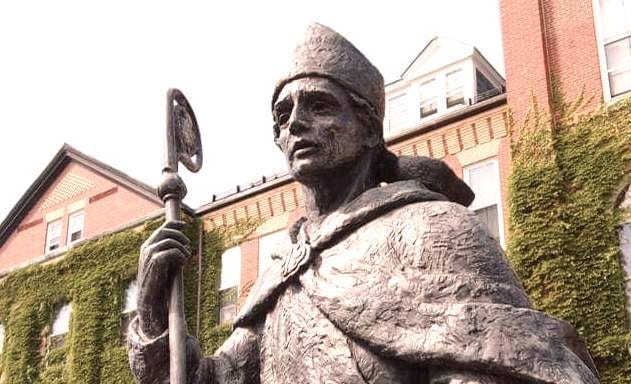
To unashamedly lift a beautiful first line from Etienne Gilson: “The only excuse one can invoke for adding a new interpretation of Saint Anselm’s argument to all of those we have already is the impossibility of resisting the temptation.”1 An argument that, since Kant’s time, has been called the “ontological argument” for the existence of God is a staple of Introduction to Philosophy and Philosophy of Religion texts and classes, which unanimously attribute its earliest formulation to Anselm, a Benedictine monk, prior and abbot of Bec and later Archbishop of Canterbury.
Typically what is presented is Proslogion chap. 2, or simply portions, even paraphrases of the chapter. In histories of philosophy, even in those that aim to be philosophical histories of philosophy, the significance and content of Anselm’s thought is often summarized under “the argument”’s rubric.2 One goal of this paper is to argue that the typical treatment of the “single argument” (unum argumentum) presented in Anselm’s Proslogion misrepresents Anselm’s proof for God’s existence, mistaking it for “the argument” rather than a portion of Anselm’s argument,3 and misunderstanding if not simply ignoring the implications of Anselm’s larger corpus for the argument and the proof.
I do not aim to make this case in a polemical way, however. Telling those who have studied Anselm’s thought as an integral whole that his thought and his argument is often misunderstood is simply preaching to the choir. Castigating those who talk about Anselm’s “ontological argument” but do not read and think through the rest of his works (or at least the Proslogion ’s other 25 chapters) for not doing their reading not only is unlikely to bring any of them to actually read let alone think through the texts sympathetically, but also smacks of a repellent textual one-upmanship.
Instead, I proffer three exegetical discussions bearing on Anselm’s Proslogion chap. 2 proof for God’s existence and the larger “single argument”. The first examines what Anselm means by the “single argument,” showing that it includes significantly more of the Proslogion than proof(s)4 of God’s existence, and indicating what provides the argument its unity.
The second focuses more specifically on the key term of both the proof(s) and the argument, “that than which nothing greater can be thought” (quo maius cogitari non potest), showing how from a broader Anselmian perspective this term and the thought corresponding to it affords a kind of access to the divine substance, God, but is not adequate to that substance, so that the caricature of the “argument” as moving illegitimately from thought or language to reality is revealed as a misunderstanding.
The third then resituates the proof within the wider scope of the argument, discussing the being or existence of quo maius cogitari non potest as an unity of its attributes.
I. The “single argument”
The term “argument” appears only twice in the Proslogion, and in the same sentence.
Considering [the previous work, the Monologion] to be constructed [esse . . . contextum] by an interlinking [concatenatione] of many arguments, I began to wonder if perhaps a single argument could be found, that required nothing other than itself alone for proving itself, and that by itself would suffice for showing [ad adstruendum] that God truly is, and that he is the supreme good requiring no other, and that he is what all things need so that they are and so that they are well, and whatever else we believe about the divine substance.5
Clearly, setting down this one argument motivates Anselm’s writing the Proslogion.6 It is so absolutely central to the text, that it is not a stretch to say practically all of Proslogion ’s philosophical value resides in or depends on the argument. But, what precisely is the argument?
One could, and many have, simply say the argument is chap. 2, or even a stripped down or paraphrased version of those passages. Some commentators have claimed to find several “ontological arguments” in chaps. 2-4.7 But, although philosophers are perfectly free to make of any portion of a thinker’s work what they wish to, in cases of great thinkers fidelity to their texts and the larger framework of thought contextualizing and animating them yields richer results, a fuller and more adequate understanding of the content and the significance of the thinker’s work.8 Anselm’s work, and the Proslogion in particular, is such a case.
Understanding what he means here by the “single argument” requires tackling the problem from several complementary angles: first, preliminary lexical examination of Anselm’s use of “argument”; second, examination of the Proslogion in light of the argument’s putative goals; third, highlighting the role of “that than which nothing greater can be thought”9 (which I will henceforth refer to as “Q”) in the entire argument.
Anselm does not use the term “argument” (argumentum) in all of his works, and when he does, does so infrequently.10 Complicating the picture, he uses verbal forms, and he uses a closely connected term (argumentatio), also usually translated “argument”. Examining passages in his corpus where “argument” occurs does not shed much further light on the Proslogion argument. What remains unclear in particular is the scope or extent of the single argument, what that argument is supposed to encompass or include.
Clearly, in certain passages, “argument” has the same sense as one of the senses we philosophers typically give the term, a self-contained and well-delineated course of reasoning or inference proceeding from premises to a conclusion. In most of these cases, however, Anselm uses the term argumentatio rather than argumentum.11 In a few cases where Anselm uses argumentum, it is in the plural, and he gives no hint where one argument ends and another begins. For instance, in Monologion ’s preface, Anselm describes the form requested for the work:
[W]hatever should be asserted through the individual investigations, in a plain style and by common arguments and simple disputation, reason’s necessity should concisely compel one to admit [breviter cogeret] and truth’s clarity should manifestly show to be the case.12
Later, he quips: “Why then has such a heap of arguments [moles argumentorum] been piled up, if this ‘nothing’ so easily demolishes their structures?”13
There are no good grounds for assuming Anselm always means by “argument” something short that can be neatly extricated from a text and fully understood and critically judged in isolation. Even if Monologion ’s many arguments can be adequately understood this way, which seems somewhat dubious given that Anselm regards it as a unified work, a meditation or an example for meditation, composed or even more literally “woven out of” (contextu ) an interlinking of many arguments, the single argument cannot.14
Consider for a moment what the Monologion and the Proslogion set out to prove through rational argumentation. God’s being or existence15 is only one of the many interconnected topics discussed. If the single argument is to replace the many arguments, we should expect it to yield us what they did. Examining the two texts, it is clear that the Proslogion treats many of the topics treated in the Monologion, albeit in less detail, and develops several undiscussed by the earlier work. Most importantly, all of these topics fall within the explicit aims of the single argument.
Anselm’s description of the argument’s demonstrative aims includes God’s being or existence, but also that God is the supreme good, that all other beings are dependent on God for their being and well-being, and very importantly, the category “whatever else we believe about the divine substance.” These are precisely Monologion’s and Proslogion’s contents, and in the latter case, those contents seem to be the argument of which Anselm speaks. A critic opposed to regarding either the whole or the majority of the Proslogion as the “single argument”, and who wants to continue to interpret the “single argument” as the proof(s) for God’s being or existence, has two interpretative options.
First, one could argue that the proof(s) for God’s existence not only textually precedes, but necessarily precedes the proofs of God’s attributes, so that the proof is really the argument, the other proofs following from it or depending on it in some way. That seems at first plausible. Would one not first have to prove the existence of the being the attributes are supposed to belong to, and only after that prove the attributes?
But, setting aside the fact that the proof for God’s being or existence in the Monologion already involves discussion of an attribute, i.e. goodness, both the supreme goodness of God and the limited goodness of creatures, there is no general logical necessity that the existence of a being be proven before its attributes can be examined and proven. All of that aside, this interpretation becomes implausible as soon as Anselm’s own explicit characterization of the “single argument” is taken seriously, for the interpretation would deny the argument’s unity and scope Anselm’s characterization unequivocally asserts.
A second, more sophisticated interpretation is possible, in which one would claim that Anselm means that the argument will first prove that God exists, and then from this corollaries, as it were, of the argument, bearing on the divine attributes, will be deduced.16 The argument would be the proof(s) for God’s existence, and all the other Proslogion material would be argumentatively “unpacked” from the proof(s).
Again, this is at first quite plausible until one carefully reads the text. For, Anselm does not argue from the conclusion that God is or exists, employing it as a premise in further argumentation to conclusions about His attributes. In Anselm’s thought, God’s being or existence and God’s attributes are intimately connected, but not for the reason and not in the way the critic assumes.17
Devoting close attention to the structure of argumentation running through the Proslogion , the term Q, “that than which nothing greater can be thought,” emerges as the common element, which Anselm uses to prove, in the later cases along with principles revealed through argument along the way:18 1) God’s being or existence; 2) God has certain attributes; 3) these attributes are not inconsistent with or contradictory to each other; 4) God is these attributes, i.e. God’s being is not something different from these attributes; 5) certain relations between God and all other (created) beings; 6) God is greater than what can be thought; and 7) God is a Trinity.
The “single argument” is not simply Q itself, however. It is rather what can be progressively unfolded or revealed by thinking through the implications of this term, dialectically answering possible objections (including those of the Fool)19 and resolving seeming contradictions by making proper distinctions and thinking matters through fully.20 The proof of God’s being or existence is only part of this argument; indeed, the proof and its linchpin Q are only given their content through the unfolding or unpacking of Q in the rest of the argument.
II. Understanding Q and the argument in an Anselmian perspective
The object of the argument, God, is an unity, and Q provides to the argument a sort of unity as well, allowing it to be a “single argument. . . that required nothing other than itself alone for proving itself, and that by itself would suffice for showing. . .” 21 Q provides the searching intellect a fruitful starting point for reasoning about God, or better expressed, to God. Proslogion, chap. 2’s context indicates this. Anselm asks God to grant him “to the degree you know it is useful to me, that I understand that you are, as we believe, and that you are what we believe,”22 and he takes up Q as “something [quidem] we believe you to be.” It is extremely important to note that Anselm does not claim or even expect that Q, taken simply on its own, is supposed to be a definition of God’s essence or nature. Q is something Christians believe God to be, but its fuller content has to be worked out through the argument.
One fruitful way of understanding Q’s function, as an expression of what God is, is in relation to the image of God. In the Monologion, Anselm asserts that the rational mind is the image of God; it can be called a “mirror, in which one can look upon. . .the image of what it cannot see ‘face to face’.”23 The rational mind has this status for two connected reasons. First, alone among all other created beings, it is able to seek out God, and it is also best able to seek out God through itself, i.e. through reflectively considering itself, the rational mind making itself its own object of investigation.24 “[T]he more diligently the rational mind directs itself to knowing itself [ad se discendum intendit], the more effectively it ascends to knowing [God]; and the more it neglects to look upon itself, the more it descends away from investigating [this likeness].”25
Second, the rational mind is a likeness to God because it can remember, understand, and love itself, and it proves itself even more an image of God in that it can remember, understand, and love God.26 The end of Proslogion ch. 1 contains an echo of this discussion. Anselm prays: “[Y]ou created in me your image, so that I remember you, I think of you, I love you. But, it is so worn away by my vices, and it is so obscured by the smoke of my sins, that it cannot do what it is made to do, unless you renew and reform it.”27 Q can be understood in light of these passages as the starting point for another way for the rational mind coming to know God. The “single argument” as a whole then is the record of such a process carried out by Anselm, like the previous Monologion written as an “example for meditation.”
Q is not the image of God, for that is the rational mind, but rather an expression corresponding to a thought which can be grasped and explored by the rational mind, since, once the expression Q has been heard, Q is in the intellect. Q, as an expression and a thought is a likeness, a simultudo, of God, but uniquely so. Not uniquely by Q being on its own the best or most adequate representation in thought or in language of what God is, but rather because the rational mind can use Q as a means for the rational mind’s own approach to that which it is an image of, i.e. God.28
In this light, in order to better understand Anselm’s perspective, two further matters require discussion. First, the argument involves a fundamental transformation of metaphysical perspective, which should be made explicit. Second, making the reasonable and warranted assumption that Anselm’s work as a whole is coherent, Q and the single argument should be examined further in light of the De Veritate and Monologion discussions about signification, likeness, and God.
The typical philosophical approach to the “ontological argument” involves commitment to a certain metaphysical perspective, an eminently commonsensical one, which is transformed into a radically different perspective if one follows out the rest of the single argument.29 Anselm’s metaphysics is best described as Christian Platonism30, and the argument leads into, but also develops within, that fundamentally different perspective.31
From the first metaphysical perspective, one can view the proof of God’s being or existence as an argument that starts from a definition of God as Q, then argues that because of the implications of that thought or linguistic expression not corresponding to something existing in reality, namely that a contradiction would ensue, something corresponding to Q must exist in reality. Understood in this way, the proof proceeds from thought or linguistic expression to reality, a procedure many have criticized as illegitimate, and rightly so, if Q is supposed to be merely a construct of the human mind, exploiting a paradox of language or thought to manufacture a “something than which nothing greater can be thought” existing in reality, to project it into and onto reality. From such a perspective, even if one accepts the proof, God ends up being implicitly thought of, if not as less than human thought, as being less than the reality in which God is proved to be, a reality that would be there and which could be known, this line of thought reasons, whether God is or not.
In an Anselmian perspective, the proof(s) of God’s being or existence, and the larger single argument can be rightly understood as proving truths about the divine substance by revealing through argument what the case is, not as proving these truths by projecting through argument a mere construct of the human mind onto reality as what the case is. What the case is can be understood, after the argument has been made, meditated upon, understood, and assented to, as having all along been the measure for Q and the argument. And, what is the case is, is not how God, once proven to exist, fits into reality, but rather how all things are in God, participate in God, are likenesses of God to some small degree.32
Integral to the argument then, is a transformation of perspective on Q, the proof, the single argument, and the rational human mind thinking about all these, in relation to God. 33 God’s being and way of being is no longer, for it never was, dependent on and determined by human thoughts or expressions and the human mind; the reverse is the case, and now the most interesting question is how Q and the single argument do mediate human understanding of the divine substance.
Passages in the Monologion and the De Veritate illuminate this question.34 Both texts articulate a common metaphysics of three mutually integrated levels of reality. Created beings35 are on one level. Expressions (verba) of those beings, in thought or in language, are on a different level, a more dependent and derivative level, for they are more or less true depending on their relationship to what they express. The more similar they are to, and the more clearly they express or signify [expressius signant], the things, the truer the expressions are.36 As Anselm says later, “created substances are quite different in themselves [in seipsus] than they are in our knowledge [scientia].37 For, in themselves they are through their own essences, but what is in our knowledge is not their essences but their likenesses.”38 We do not know the reality of created things directly, and a fortiori all our expressions of them in thought and language are not the same as the things expressed.
Anselm distinguishes between three different ways of expressing things, which vary in degrees of likeness to the things. There is expression through perceptible signs, e.g. the word “man”. There is thinking to oneself using signs inwardly, e.g. thinking the word “man”. Last, there is “not using signs but rather expressing things or states of affairs themselves [res ipsas] inwardly in our minds by imagination of corporeal things or by understanding of reason in place of the diversity of the things themselves”. Examples of these are thinking “man” through the image of the body, i.e. imagining the sensible figure, or through reason, i.e. thinking his universal essence.39
So, very briefly put, there is the order of created beings, and there is the order of human thought and language, which is less real than the order of created beings, dependent on and derivative from it, admitting various degrees of likeness to or expression of the beings. “Every likeness or image is more or less true to the degree that it more or less imitates the thing of which it is a likeness.”40 The De Veritate, dealing with affirmations and negations in language and thought, echoes this, for “the truth that is in the existence of things. . . is the cause of the truth that is of thought and the truth that is in propositions.”41
There is another order, however, one that is quite complicated for us to express. In the De Veritate, “[t]he truth that is in the existence of things is an effect of the Supreme Truth.”42 Everything, at every time and every place, “is in the Supreme Truth and receives from the Supreme Truth what it is, insofar as it is, [and] that it could be different from what it is there [in the Supreme Truth]”43 The Monologion discussions, clearly presupposed by the De Veritate, provide further clarification of this level. To return to Anselm’s distinction between created substances as they are in themselves [in seipsis], and as they are in our knowledge, created substances in themselves are not entirely true, real, what they are.
“Every created substance is more truly in the Word, i.e. in the intelligence of the creator, than it is in itself,”44 Anselm argues. Created things have essences, they are in-themselves, but none of them have a “simple or absolute essence.” Instead, the Word is “their true and simple essence”, of which they are “just barely imitation[s].”45 The Word is the second person of the Trinity, the Son through which God creates everything, the model (exemplum) from which all things are made from nothing, and in which those things are “what [quid], or what kind [qualia] or in what way [quomodo] they were going to be” even before their creation.46
In this three-level metaphysics, human thought and language are likenesses of things, and things are likenesses of what they truly are in the divine substance, and this latter is the divine substance. Everything has some degree of truth and being, depending on the degree of likeness. Now, this metaphysics understood, a very interesting question can be asked: what is the condition of Q and the single argument? They are, after all, thoughts expressed in language, so they are only likenesses, more or less adequate, more or less similar, to what they are likenesses of.
Regarded in isolation, Q, “that than which nothing greater can be thought”, may be viewed as simply a verbal formula or a corresponding thought, which then should dimly reflect or resemble in some way its object, if indeed there is anything corresponding to it. Regarded in an Anselmian perspective, however, there is not something corresponding to Q, but rather Q corresponds to something, it expresses it in some way(s). To say this, however, is not yet going far enough, for this still represents Q in an artificial and abstract isolation, not from its ultimate object, but from the single argument and even more importantly from the rational minds that carry out, understand, and meditate upon and though the argument.
As Anselm reminds Gaunilo, Q as an expression (significati ) contains in itself (in se) “such a power of bringing forward in discourse [tantam. . . vim. . . prolationis]” 47that Proslogion ’s probative goals can be brought about by unpacking it into the single argument.48 Yet, unless Anselm should be taken to have abandoned his position developed at length and in depth in the Monologion, like the “many arguments” Proslogion ’s argument is a substitute for and improvement upon, Q and the single argument remain characterized by these passages:
often we see something not as it is [proprie], i.e. precisely as the thing itself is, but by some likeness or image. . . . So then, we speak about and do not speak about, we see and do not see, one and the same thing [unam eandemque rem]. We speak about it and see it through another, but we do not speak about it and see it through its own proper nature [per suam proprietatem]. For this reason, nothing prevents what we have argued about the Supreme Nature from being true, and nevertheless that Supreme Nature remains ineffable, if one assesses that it is never expressed through the proper nature of its very own being [per essentiae suae proprietatem expressa], but rather described or sketched out through another thing [designata per aliud]. 49
Neither Q nor the single argument express God exactly as God is. They do not even express God through God’s proper nature, but only through something(s) else. And yet, they are not prevented from being true, in the several senses of truth the De Veritate propounds for thoughts and propositions. They are true in that they signify what the case is, namely about God, but they do this because they “signify what they were made to signify,” and they “signify what they received [the capability] to signify.”50 Q and the single argument have a relative degree of adequacy to their object, God, and as expressions and thoughts, they do what they ought to do to the degree they are able to, or put better, were made to and received the capability of doing.
Earlier, a relationship between Q and the human rational mind as image of God was pointed out. Now, that relationship can be understood more determinately. Neither Q nor the single argument are the image of God, and quite clearly the human rational mind of itself is not a particularly faithful likeness. It can become more so, and it can so become through Q and the single argument, understood now in an Anselmian perspective as never being fully adequate, fully true representations or expressions of God, but as being, to use a non-Anselmian formulation, “good enough”.
These expressions being “good enough”, however, depends precisely on them being thought through by the actively seeking and reasoning human rational mind,51 and this even involves the realization of the inadequacy, or only partial adequacy, both of the human mind and of Q and the single argument. “That than which nothing greater can be thought” ceases to be a mere thought or verbal expression, and becomes the occasion, or if you like, tool, for reflection and mediation by the rational human creature upon itself and upon God, thereby coming to know both better in the process.
III. The Unity of the Divine Attributes and Being
From the Anselmian perspective explored (albeit only a little) in this paper, conventional interpretations of the “ontological argument” (more properly called the proof of God’s existence or being) appear to have largely missed what Anselm was doing, not least because doing what critics typically charge him with, or more accurately Proslogion II, would go against Anselm’s own larger thought, in particular the rest of the single argument in Proslogion. From a fuller perspective, which develops through reflectively thinking the matters through, the “that God truly is” and the other goals of the argument are not different things that are proved. They are different as expressed in language, and they are different as articulated in our thought, at least at the start and through a considerable portion of the thinking recorded in the Proslogion, but they are not different in the object of that thinking, God.
As Anselm’s thinking, and as ours following along with his, becomes gradually more and more adequate to its object, the difference comes to be better and better understood as a reflection of the limitations of our thinking, knowing, and understanding. At the same time as these limitations come into view, the human mind also partly, and only partly, surpasses these limitations. Viewed in this way, Q is an exemplary formulation of the divine substance, indicating what the divine substance is by way of indicating to human thought the limitations of human thought, spurring the human thinker to try to explore Q and unpack this “that than which nothing greater can be thought” through the single argument.
As noted earlier, Q is used by Anselm to argue for God’s being or existence, God’s attributes, and the unity of these attributes, meaning that God’s being is not something different from His justice, or goodness, or wisdom, or life, or eternity; nor are these attributes fundamentally different from each other.52 It is also used to argue two other important things: God is greater than what can be thought, and God is a Trinity. These have important implications for God’s being or existence and attributes, for these also allow the thinking human mind to grasp how God is His being or existence, and attributes, and unity of being and attributes. The insight afforded by this is not that God is this unity, and then just happens also to be greater than can be thought and a Trinity; these latter are just as essential to God as the others. To rightly understand what is going on in Proslogion II, at least from an Anselmian perspective, involves retroactively, so to speak, reading all these things that one perhaps did not realize about God, about “that than which nothing greater can be thought”, into the object of the proof.
These unified attributes are “whatever it is better [melius] to be than not to be,”53and God does not have these attributes; rather he is the attributes, e.g. “the very wisdom by which You are wise”, “the goodness by which You are good.”54 To truly know these attributes, to truly know what goodness or wisdom, life or eternity, is, would be to truly know God. Our grasp on fundamental metaphysical, epistemological, and moral principles, notions, or realities, is always more impoverished than we realize. Ultimately, as chaps. 15-17 of Proslogion indicate, they are “greater than what can be thought,”55 they “inhabit an unapproachable light,”56 they are in God “in Your ineffable way, You who have given them to things you have created.”57
From this Anselmian perspective, one could say that the proof for God’s being or existence becomes transformed in our understanding, becoming an integral part of the single argument. It is not, however, the proof or the single argument that is actually transformed in taking this perspective the argument makes available, coherent, and comprehensible, but rather our understanding of it, allowing us to better think and understand, perhaps for the very first time for some of us what Anselm so “eagerly embraced when it at last “offered itself”.58
NOTES
1: Etienne Gilson, “Sens et nature de l’argument de saint Anselme”, Archives d’histoire doctrinale et littéraire du Moyen Age , v. 9 (1934), p. 5. [Author’s translation. All translations of Anselm and of the other authors cited are, unless otherwise noted, those of the author. ]
2: A few representative examples of this tendency suffice here. The seminal essays assembled in The Many-Faced Argument: Recent Studies on the Ontological Argument for the Existence of God . John Hick and Arthur C. McGill, eds., for instance, focus almost entirely on philosophical and theological interpretations of these three chapters. Gregory Schufrieder’s An Introduction to Anselm’s Argument , while correlated to the Monologion , again discusses the “argument” only in reference to Proslogion II-IV.
Jasper Hopkins, who in other places does discuss the larger Proslogion argument, in his A Companion to the Study of Saint Anselm , mentions briefly that “Anselm presents what he takes to be a single argument from which may be inferred the fact of God’s existence together with various features about his nature,” p. 69-70, then devotes the entire rest of the chapter, “Ontological Argument” to discussion of Proslogion , chaps. 2-4, and then jumps immediately in the next chapter, “Doctrine of the Trinity”, to discussion of the Monologion and other works.
Toivo J. Holopainen’s “The Fool and the Single Argument in Anselm’s Proslogion”, Les philosophies morales et politiques au Moyen Age B.C Bazan , ed., while acknowledging that the unum argumentum is supposed to prove not only God’s existence but also that God has the attributes he is believed to have, mistakenly ascribes this double formulation to the Proemium (rather than II), and again focuses entirely on the proof of God’s existence.
Classical and Contemporary Readings in the Philosophy of Religion, John Hick, ed. 3rd ed. provides a typical example of textbooks by including only Proslogion II-IV.
3: This is not a radically new position in Anselm scholarship. R.A. Herrera , who considers the entire Proslogion a single argument writes: “Although it is true that only the first stage of the argument, comprising only three out of twenty-six chapters, has given Anselm a place in the history of philosophy, it has also most probably contributed to the depredations which the argument as a whole has suffered.” Anselm’s Proslogion: An Introduction , p. 25.
Dom Paschal Baumstein, O.S.B., who first and most graciously stimulated my thinking about the unum argumentum in Proslogion argues this interpretation in an as-yet unpublished paper “St Anselm and the Necessary God”, and in his paper “How Much of Proslogion is Necessary for Anselm’s Unum Argumentum ?”, presented in 2002 at the 2nd Saint Anselm Conference. In the latter, he notes: “When viewed as a whole, Proslogion renders an argument that is both richer and more convincing than its truncated counterpart,” p. 3. “ Proslogion , as it continues, does far more than explicate. Instead of expounding upon points and clarifying them, in a very literal sense Anselm perfects his argument. He gives it fullness, complementarity. Moreover, therein he moves to satisfy his innocent purposes, all of his announced purposes”, p. 7.
Eileen C. Sweeney takes a similar tack: “While it is clearly anachronistic to think of the argument for God’s existence as the single argument, in the end I am not sure it matters whether we think of the argument as the original formula or the formula together with the conclusions that follow from it, for Anselm thinks of the attributes as following as necessarily as existence from the original formula.” “Anselm’s Proslogion , the Desire for the Word”, The Saint Anselm Journal , v. 1, n. 1, p. 23 ftnt. 26.
André Audet takes the “argument” to be the formula, but indicates the unity of the Proslogion : “[T]he unique and persistent argument, the quo maius cogitari non potest,intervenes at every one of the Proslogion ’s dialectical stages [ étapes ].” “Une source augustinienne de l’argument de saint Anselme”, in Etienne Gilson: Philosophe de la chrétienté , p. 125.
Dom Baumstein , Sweeney, and Jacques Paliard, in “Prière et dialectique: Méditation sur le Proslogion de saint Anselme”, Dieu Vivant , v. 6 (1946) also call attention to the importance of Anselm’s prayer, chap. 1, in the argument.
I do not entirely agree with interpretation of the whole of Proslogion as the unum argumentum , for two reasons: 1) Anselm calls the last three chapters coniectationes ; 2) Anselm says in the prooemium that he wrote the Proslogion about the argument itself ( de hoc ipso ) and about several other things ( et de quibusdam aliis ). Accordingly my position is that the unum argumentum is Proslogion chaps. 1-23.
4: I allow the possibility that there are several proofs of God’s existence in Proslogion, chaps. 2-4, an issue on which my exegetical interpretation of Anselm needs not take a position.
5: Proslogion, prooemium, in S. Anselmi Cantuariensis Archepiscopi opera omnia , ed. Dom F. S. Schmitt, O.S.B. (Edinburgh: Thomas Nelson and Sons. 1940-1961) , vol.1 p. 93. All further citations of Anselm’s work are from the O.O ., and will be designated by the work’s title, chapter, and O.O. page number (not the volume, since all are from vol. 1).
6: Eadmer, Anselm’s biographer, provides an interesting discussion of this motive, supplying additional information in three respects: 1) an account of the process of Anselm’s discovery of the single argument; 2) an account of the disappearance or destruction of previous drafts; and of most interest here 3) an account of what the “one single and brief argument” is supposed to be able to prove, “what is believed of and preached about God, namely that He is eternal, unchangeable, omnipotent, entirely present wherever he is [ubique totus], incomprehensible, just, pious, merciful, truthful, truth, goodness, justice, and some other things, and in what way these are one thing in Him.” Eadmeri monachi Cantuariensis, Vita Sancti Anselmi archiepiscopi Cantuariensis/The Life of St. Anselm, etc . , ed. R. W. Southern, p. 29. My translation of this passage diverges slightly toward a greater literality than Southern’s.
7: For a variety of views on this, cf. Norman Malcolm, “Anselm’s Ontological Arguments”, Philosophical Review , v. 69 (1960); G. Nakhnikian, “St. Anselm’s Four Ontological Arguments”, in Art, Mind, and Religion ed. W. H. Capitan and D. D. Merrill (Pittsburgh: 1965); Jasper Hopkin’s A Companion to the Study of St. Anselm , chap. 3.
Gilson strongly resists the tendency to dissociate c. 2 from the other chapters and thereby discover more than one “argument”, arguing: “the Proslogion ’s proof, even though it reaches its object in chapter II, has its full intelligibility in chapter III. . . . This is why chapter III of the Proslogion must not, under any pretext, be considered as separable from chapter II, nor the inverse.” loc. cit . p. 13. Unfortunately, Gilson himself uncritically uses the term “argument” to refer to the c.2-3 proof of God’s existence.
8: It is quite possible that to many contemporary philosophers such a fuller and more adequate understanding will not be regarded as of philosophical value. That, of course, involves a larger and much more controversial issue, too large to enter into here, namely the criteria for ascertaining and adjudging the philosophical value of past thinkers’ works, criteria that will be highly dependent on the far from uncontroversial question of what one takes philosophy in essence to be.
9: Somewhat lost in the English translations is Anselm’s insouciance for using exactly the same Latin expression. He is willing to, and does shift terminology slightly without significantly changing the sense or signification. For example, in chap. 2, we find: 1) quo nihil maius cogitari possit; 2) quo maius cogitari nequit ; and 3) quo maius cogitari non ualet . He uses the first two in chap 3, quo nil maius ualet cogitari in chap 5. This range of terminological variance can be taken as a sign that Anselm does not identify Q, let alone the single argument, solely with the verbal formula.
In addition, as Hopkins points out, “in two different chapters (Proslogion 14 and 18) Anselm uses the phrase ‘quo nihil melius cogitari potest’ (And this phrase seems to be a straightforward substitution for ‘quo nihil maius cogitari potest ’), Anselm of Canterbury, vol. 4: Hermeneutical and Textual Problems in the Complete Treatises of St. Anselm (New York: Edwin Mellen 1976), p. 121. Anselm makes the transition from maius to melius earlier, however, in chap. 3: “Si enim aliqua mens posset cogitare aliquid melius te, ascenderet creatura super creatorem, et iudicaret de creatore; quod ualde est absurdum.” O.O., p. 103.
10: Terms frequently translated as “argument” occur in Anselm’s works as follows: in De Grammatico , 6 times (2 as argumentatio, 4 as argumentum); in Cur Deus Homo , 3 times (2 as argumentatio, both used by Boso, the student, 1 as argumentum ); in Monologion and Proslogion, argumentum 2 times each; in De Veritate, 1 argumentatio; in De Processione and De Casu Diabolis 1 argumentum each.
In the Pro Insipiente, Gaunilo uses argumentum 4 times and verbals from arguere 2 times. In his Responsio , Anselm uses argumentum 3 times, argumentatio 3 times, and a verbal once.
11: Anselm’s critic, Gaunilo, however, uses only argumentum and two verbals. Clearly, he views Anselm’s “argument” only as a self-contained and well-delineated course of reasoning or inference proceeding from premises to a conclusion, and takes the argument to be only the proof for God’s existence.
12: Monologion, prologus, p. 7. This breviter, “quickly”, given the length and complexity of the argumentation in Monologion , should lend some needed context to Eadmer’s characterization in the passages cited above of the Proslogion argument as “one single and brief argument” (uno solo et brevi argumento). Providing additional and complementary contextualization of brevis is the student’s remark in De Casu Diaboli, penultimate chap. 27, asking the teacher to keep providing brief answers (breuiter respondere) to the student’s questions. The “brief” answers in prior chapters involved lengthy, complex, and progressive argumentation.
13: Mono, c. 19, p. 34. Anselm indulges himself in an unfortunately untranslatable (at least in available translations and for my ability) play of words in this passage. Moles , whose root appears in the “piled up” (molita), “demolishes” (demolitur), and “structure” (molimina), can signify a “heap”, “pile” or “mass”, i.e. unordered material, but it can also signify a massive construction or edifice, i.e. ordered materials. The Monologion can be regarded in both of these ways at the same time.
14: R.A. Herrara’s “St Anselm’s Proslogion : A Hermeneutical Task”, Analecta Anselmiana , vol. 3, makes several relevant points:
1) “St. Anselm’s thought is concentrated and encapsulated in the Proslogion , and because of this presents unique hermeneutical difficulties,” p. 141.
2) a preliminary step involves distinguishing Anselm’s argument from “the two principal ‘obstacles’ which, in our opinion, are blocking the way to an adequate comprehension of the Proslogion argument: Descartes and St. Thomas Aquinas,” p. 142.
3) “The very center of St. Anselm’s thought is his theory of rectitude . . . . the ‘rectitudes’ (will, intellect, activity) together constitute the human path to be followed to their source in the Supreme Rectitude, God.
A correlation holds between the three, hence the interrelation between the knowledge of God, self-knowledge, and self-perfection,” p. 143. “is it legitimate to isolate Proslogion II, III or any section or series of sections from the totality of the work? . . . The argument must be considered as a whole,” p. 144.
15: I use the expression “God’s being or existence”, because it is not clear that “exists” is always how esse ought to be translated. This is a complicated issue, on which I have only three things to remark, which do not resolve the issue.
1) in the chap. 2 proof, Anselm uses both esse / est , and existit ; likewise, throughout his corpus he uses esse in such a way as is often translated “exists”, but also uses the verb existere;
2) complicating the picture, in Monologion chap. 6, explaining “how one should understand this nature to be [est] through itself and from itself,” Anselm suggests we view it “in the way that it is said that light [lux] shines [lucet], or is through its very self and from its very self shining [ ucens]. For, as light and shine lucere] and shining are related to each other [sese habent], so are essence [essentia] and be [esse] and being [ens] (i.e. existing [existens] or subsisting) to each other.” p. 20. Quite clearly, in Anselm’s view, at least for God, being, essence, and existence are not neatly separable from each other.
3) if one takes seriously the Monologion chaps. 18-24, and Proslogion chaps. 13 and 19-21 discussions, Anselm does not believe God to exist in the same way as mundane beings, or even as the universe as a whole.
Gilson notes that the meaning that one assigns to “is” depends fundamentally on am interpretative choice about the nature of the Proslogion . “If one decides that it is philosophy, then it is a proof, and is has one meaning [ veut dire une chose ]. If one agrees that it belongs to theology or mysticism [i.e. the interpretation advanced by Stolz], then is means something else.” loc cit . p. 40. I will go further and say that, even regarding it as philosophy, how esse /est , and existit should be translated likewise depends on one’s interpretative choice about the nature of the Proslogion .
16: Michael Corbin, S.J., at first glance, seems to articulate such an interpretation. In his view, there is a difference between what he calls the “argument-Name and the other names relative to the existence as well as the essence of God. . . . [T]he Proslogion uses three Names to signify the lordly Thou he addresses. These three Names of God’s unique transcendence do not signify in the same way and can be enumerated according to the order of their appearance:
I. Quo nihil maius cogitari potest (Proslogion II)
II. Summum omnium (sive maius omnibus) (Proslogion V)
III. Quiddam maius quam cogitari potest (Proslogion XV).” “La significations de l’unum argumentum du Proslogion ”, Anselm Studies , vol. 2 (1988), p. 205-6.
Even if one accepts his rather dubious Barthian importation of the notion of divine names into Anselm’s work, Corbin’s position would, while interesting and suggestive for its own sake, have no bearing here, since the divine attributes are still discovered through Q in the course of the single argument. That II and III would be derived from I (Q) has no bearing here, since they simply come into view as content of the single argument, rather than providing bases for further argumentation.
17: Such an interpretation of Anselm, were it correct, would make Anselm highly vulnerable to the Pascalian critique of the “God of the philosophers and the God of Abraham, Isaac and Jacob”, much more so than proofs from effects would be, for the assumption would be that God’s attributes could be simply spun out of the proof that He exists.
18: In his Response to Gaunilo, Anselm provides the elements of an explanation of how Q works in the argument. As opposed to “that which is greater than everything else”, “[Q] does not need something else besides [Q] being said. . . .[Q] proves things about itself [ de se ] through itself [per seipsum].” Clearly what Anselm has in mind is not that the expression proves things about the expression or simply through the expression , but about and through what truly is greater than that which can be thought, i.e. God.
Anselm also indicates that the process of proving or argumentation involves the thinking and searching human being bringing additional elements to the argument. “For indeed since everything less good, insofar as it is good, is similar to a greater good, it is clear to any rational mind that by progressively ascending [conscendendo] from lesser goods to greater goods, from those things than which something greater can be thought we can infer [conjicere ] that than which nothing greater can be thought.” Responsio , c. 8, p. 137
19: This is a central motif of Anselm’s argumentation, not only in the Proslogion , but in his philosophical-theological works as a whole. The justification and entreaty Anselm places in a student’s mouth in De Casu Diaboli, chap. 27 articulates this well: “But do not grow weary of providing brief responses to my foolish [fatuae] questioning, so that I might know how I should respond to other people asking the same thing(s). Indeed it is not always easy to respond wisely to one who asks foolishly [insipienter].”, p. 275. In the preface to Monologion, Anselm recounts that his brethren insisted that he “not disdain to meet head on [obviare] such simpleminded and almost foolish [fatuis] objections that might occur to me,” p. 7, and, he explicitly indicates himself addressing these at one point in chap. 6.
Simon Decloux, “Philosophie chrétienne, hier et aujourd’hui” in Pour une philosohie chrétienne: philosophie et théologie , primarily discussing the authors (Gilson, Maritain, Blondel) involved in the 1930s Christian Philosophy debate in France, distinguishes (following Blondel) two different conditions (statutes) of Christian philosophy: one that follows an option for faith, and “a philosophy that situates itself, in some way, in the ‘before’ [of the other philosophy], and which has as its decisive motivator [moteur] Christian reason’s necessary dialogue with unbelief,” p. 30. “It implies, in a manner constitutive of it, dialogue with the unbeliever or unbelief,” p. 31. Decloux adds: “Already Saint Anselm, speaking with his monks, discovered the hidden and in some way necessary presence of the ‘Fool’ at the heart of their common rational reflection.” p. 37. Paliard also calls attention to the relationship between an option, humility, and reflection, loc. cit ., p. 61. For further discussion of this theme of the option, cf. my “The Ontological Proof and the ‘Unique Necessaire’: Maurice Blondel’s Examination of the Proof in Anselm, Descartes, and Malebranche”, Saint Anselm Studies , Vol 2, no. 2.
For further illuminating discussion of the importance of engagement with unbelief, cf. Thomas O’Loughlin, “Who is Anselm’s Fool?”, The New Scholasticism , vol. 63, n. 3 (1989); Holopainen’s “The Fool and the Single Argument in Anselm’s Proslogion”; Marilyn McCord Adams, “ Fides Quaerens Intellectum : St Anselm’s Method in Philosophical Theology”, Faith and Philosophy, v. 9, n. 4 (1992); Audet’s “Une source augustinienne de l’argument de saint Anselme”; and R.A. Herrera, “Augustine’s Concept of Purification and the Fool of the Proslogion”, Anselm Studies , v. 2 (1988)
20: Anselm makes this clear at the end of his Response to Gaunilo. “This signification [Q] contains in itself such a power of providing expressions [vim prolationis], that. . . by the very fact that it is understood or thought by necessity it is truly proved both to exist and to be whatever it is befitting to believe about the divine substance. For, we believe about the divine substance whatever can be thought absolutely to be better to be than not to be. For example: it is better to be eternal than not eternal, good than not good, even this very good rather than not this very good. And nothing of this sort can not be that than which nothing greater can be thought. So, it is necessary that ‘that than which nothing greater can be thought’ be whatever should be believed about the divine substance.” p. 138-9
Ironically, Gaunilo focused entirely on the proof for God’s existence, calling that weak, but praising the entire rest of the work, missing altogether the connection between the proof(s) for God’s being or existence and the rest of the single argument: “The other things in the work are so truthfully, evidently, and magnificently discussed, indeed so full of usefulness and redolent of a certain fragrance of pious and holy feeling, that in no way should these be overlooked on account of those things that are argued. . . in the first chapters.”, c. 8, p. 129.
With most modern interpreters and critics of Anselm, nearly the opposite is the case. M.J. Charlesworth, not merely a commentator but a translator of Anselm, is representative of this tendency. His commentary in his St. Anselm’s Proslogion , devotes 18 pages to chap. 2, 5 pages to chap. 3, 2 pages, to chap. 4, and 5 pages to chapters 5-26, all told 5 times as much space to the proof(s) as to the rest of the single argument! He remarks: “The remaining chapters. . . are taken up mainly with a discussion of the various attributes. . .. For the most part St. Anselm’s discussion is on a fairly general level and it does not have anything of the philosophical depth and sophistication of Aquinas’ treatment of the divine attributes, for example .” p. 78.
21: As noted earlier, Audet mistakenly takes Q in fact to be the single argument. But, his interpretation is on the whole correct, and brings out a very important point: “It is [the single argument] that, in chap. 5, justifies the uncovering of God’s attributes and the dialectical rule of their attribution, the same as the one Monologion chap. 15 already offered. It is again the same argument that intervenes in Proslogion chap. 15. . . .From the multiplicity of God’s attributes, the argument allows one to pass through to understanding of their supreme and transcendent unity. . . . At that point [étape] the argument’s dialectical sufficiency in a way rejoins the absolute sufficiency of God Himself.” “Une source augustinienne de l’argument de saint Anselme,” p. 125
22: Pros , c. 2, p.101
23: Mono , c. 67, p. 78
24: Mono , c. 66, p. 77
25: Mono , c. 66, p. 77
26: Mono , c. 67, p. 78
27: Pros , c.. 1, p. 100
28: Paliard indicates this: “The entire meaning of the proof is to show that the soul is not a rational soul – mind and soul – except by that image, even as effaced as it is.” loc. cit ., p. 59, nt. 1.
29: Quite clearly, the Monologion also leads into this perspective, as does the De Veritate It is not entirely correct to say that Anselm simply presupposes this perspective. Rather, he develops, explores, comes to understand, and articulates it.
30: That Anselm’s thought is in a broad sense Platonic or neo-Platonic is a commonplace of literature on Anselm and of histories of medieval philosophy, although descending to the levels of particulars there is not such broad agreement. On Anselm’s Platonism or Neo-Platonism, cf. Jasper Hopkins, A Companion to the Study of St. Anselm , and Charlesworth’s Introduction to St. Anselm’s Proslogion
For more specific treatments, cf. François-Joseph Thonnard, A.A., “Caractères augustiniens de la méthode philosophique de saint Anselme”, Spicilegium Beccense , v. 1; André Audet , “Une source augustinienne de l’argument de saint Anselme”; Vernon J. Bourke, “A Millennium of Christian Platonism: Augustine, Anselm, and Ficino” in Anselm Studies , vol. 2; Kurt Flasch, “Der philosophische Ansatz des Anselm von Canterbury im Monologion , und sein Verhältnis zum augustinischen Neuplatonismus”, in Analecta Anselmiana , vol. 2; F.S Schmitt, O.S.B., “Anselm und der (Neu-)Platonismus”, Analecta Anselmiana , vol. 1; and Katherine Rogers’s more recent The Neoplatonic Metaphysics and Epistemology of Anselm of Canterbury
31: Edward J. O’Toole discusses this in terms not of different metaphysical perspectives, but of different logic. “In [the Monologion and Proslogion ] the existence of God is ‘proved’, and it is our precise point that the logic of the scholastic (and for that matter, the logic of today) just does not work in structuring such proofs as these. Yet it is certainly a fact that the logic of Plato or Bonaventure, in fact of the whole Augustinian school, is not this kind of logic. . . . .These is in fact another ‘kind’ of logic which is structured essentially different from the logic of the scholastics. It is the logic found in the Platonic Dialogues; it is the logic of John of the Cross and Bonaventure; it is, we shall see, the logic also of St. Anselm.” “Anselm’s Logic of Faith”, Analecta Anselmiana , vol. 3, p. 148.
O’Toole argues suggestively that this non-logistic, non-Aristotelean, and non-Scholastic type of logic (also including “the restrictive empiricism of Hume or Dewey or James”, p. 150) is also at work in Thomas Aquinas’ Five Ways, the Hegelian Logic, and the “genuine empiric[ism]” of the Christian mystics. In my view, he is most correct in correlating the logic he sketches with Maurice Blondel, who did develop a “concrete logic”, but who seems to have greatly under-evaluated Anselm’s thought. On this, cf. my “The Ontological Proof and the ‘Unique Necessaire’: Maurice Blondel’s Examination of the Proof in Anselm, Descartes, and Malebranche”, Saint Anselm Studies, vol 2, no. 2.
F. Sontag, in “The Meaning of ‘Argument’ in Anselm’s Ontological Proof”, Journal of Philosophy , v. 64 (1968), contrasts Aristotelean, Cartesisian, Empiricist, and Kantian views and presuppositions about “arguments” with Anselm’s use of argument, “suggest[ing] that the force and power of Anselm’s thought would be understood much more clearly in an interpretation were made with two quite different works in mind: (1) Plato’s Republic , with its concept of dialectic and the preparation of the mind necessary for true insight; and (2) St. Augustine’s Concerning the Teacher , with the doctrine of the ontological status of language an how words function in the learning process.” Unlike O’Toole, Sontag, thinking largely in the ambit of Hartshorne and Malcom, discusses primarily the proof(s) for God’s being existence, neglecting practically every other topic of the Proslogion single argument.
32: This reversal of perspective takes place in Proslogion , ch. 19: “But, since without you nothing is, you are not in place or time, but everything is in you. For, nothing contains you, but you encompass everything., p. 115. Chs’ 20-21 follow this up. These topics are discussed at much greater length and in greater detail in Monologion , chs. 18-24.
Proslogion chs. 12, “that God is that very life by which He lives, and likewise for other similar things”, and 17, “that in God are harmony, fragrance, softness, beauty, in His ineffable manner”, also develop this shift in perspective.
33: Paliard expresses this well: “Through apparent contradictions to overcome, Anselm’s effort consists in eliminating the human point of view in order to orient himself toward the true point of view which is that of God’s greatness.”, “Prière et dialectique”, p. 65. He regards this movement as particularly evident in Anselm’s treatment of God’s justice and mercy in Pros. chs. 8-1, a treatment discussed at considerable (perhaps even tedious) length by my “Mercy and Justice in St. Anselm ’s Proslogion ”, American Catholic Philosophical Quarterly , vol. 80, no. 1. Unfortunately, that article discusses only the Proslogion and the Monologion , ignoring highly relevant passages in Anselm’s other works, particularly the De Concordia . Cf. Also Michel Corbin, S.J. “La significations de l’ unum argumentum du Proslogion”, Anselm Studies , vol. 2 (1988), p. 210-218
34: Gilson led the way in indicating De Veritate ’s relevance to understanding Anselm’s argument. “Unless the Proslogion ’s argument is to be empty of meaning, it must of necessity be placed within a doctrine of truth, which would be such that the existence of truths always presupposes that of their objects. Such is exactly the case. Aside from the Proslogion, Saint Anselm wrote the De Veritate, a dialogue we little discuss, but which is not any less the epistemological foundation of all his teaching.” loc. cit. p. 9.
Gilson, however, wrongly turns the De Veritate into a hermeneutical philosopher’s stone “Whether it be a matter of God, human freedom, or of knowledge, it is to that work one must always return in order to understand Anselm’s thought.” loc. cit. p. 9-10.
And, while making the right points, Gilson grounds therm too exclusively on the De Veritate: “Saint Anselm’s argument is neither a verbal-play nor a vicious circle. He does not deduce existence, since he moves from the start in the existential order, such as the De Veritate defined it. It is not a vicious circle, since the argument does not presuppose the existence of God, but rather finds it. It finds it precisely by setting in full light the rational necessity of affirming existence of God, a necessity that, according to the De Veritate ’s epistemology, cannot have any other cause than that of its very object.” p. 15.
For judicious criticism of Gilson’s position on the De Veritate , c.f. J. Rassam, “Existence et vérité chez saint Anselme”, Archives de philosophie, vol. 24, n. 2 (1961).
Unfortunately, the relevance of the De Veritate (and Anselm’s broader theory of truth, which must include relevant passages from the Monologion) to understanding both Anselm’s Proslogion proof(s) for God’s existence and single argument has been largely unexplored. As recently as 1996, Englebert Rechtenwald could write: “Even though since Gilson the view, that De Veritate assumes a key role [Schlüsselstellung] for the understanding of the Anselmian corpus, has been established I have in the course of my further research discovered only three authors who have sought to make this key serve for the interpretation of the Anselmian proof for God’s existence: Kurt Flasch, Hans-Joachim Werner and Adolf Schurr.” “Das id quo maius cogitari non potest als rectitudo : Anselms Gottesbeweis im Lichte von De Veritate ”, p. 145
35: The term Anselm most often uses for these is essentia , which does not always have the same signification as the English term “essence”. Essences are not all substances, as Anselm indicates in noting that “even if [the will and the turning of the will] are not substances, they still cannot be proven not to be essences, since there are many essences other than those which are properly called substances.” De Casu Diaboli , c. 8, p. 245.
36: Mono , c. 10, p. 25; c. 31, p. 48
37: One might raise an objection here, protesting our moving from thought and language in general to knowledge, as if these were being conflated. Such an objection would simply be quibbling, however, since if even our knowledge is only likeness, a fortiori our thought and language are as well.
38: Mono , c. 36, p. 54-5
39: It should be noted that this will involve reflexively grasping human as rational, and thereby in some way as image of God.
40: Mono , c. 31, p. 48
41: De Veritate, c. 10, p. 190
42: De Veritate, c. 10, p. 190
43: De Veritate, c. 7, p. 185. This is actually put as a question, which gets a negative response: “An putas aliquid esse aliquando aut alicubi quod non sit in summa ueritate, et quod inde non acceperit quod est inquantum est, aut quod possit aliud esse quam quod ibi est?”
The last phrase of this passage has been translated differently from my rendering, as “or is able to be other than what it is in the Supreme Truth?” There is an ambiguity here, i.e. whether the “aut quod. . . . ” should parallel the “quod inde” or the “quod est inquantum est,” and since either rendering makes good sense and fits Anselm’s thought (given that in Mon., c. 28, and Pros, c. 22, only God is what he is, all other beings being other-than -they are), I would suggest it is an intentional and productive ambiguity on Anselm’s part, so that it should be interpreted both ways. For a similar possible intentional ambiguity which that author ascribes to Anselm, cf. “Mercy and Justice in St. Anselm ’s Proslogion ” , p. 51.
44: Mono , c. 36, p. 55
45: Mono , c. 31, p. 50
46: Mono , c. 9 p. 24
47: Responsio , c.10, p. 138. Gilson makes an important point about how the significatio in this phrase should be understood, and how it was understood in contemporary Anselm interpretation. In his important and influential Anselm: Fides Quaerens Intellectum, Karl Barth maintained that Q was a name of God. Gilson argues: “[H]e does not speak at all of any name of God. Significatio is not related here to a nominis, which is neither in this sentence nor the one preceding, but to probationis . Let us translate it, as Mr. Koyré did: ‘For, the meaning of this proof contains (in itself) such a power that the real existence. . . etc.’ It is always a matter here of a certain cogitatio , not of a nomen of God.” p. 40.
Gilson rightly emphasizes that Q, and its power, is not something purely verbal, that it depends on Q being expressed in thought as well as words, i.e. that the probative force is only engaged “by the very fact that it is understood or thought” ( eo ipso quod intelligitur uel cogitatur ).
But, Koyré’s translation, which Gilson relies on, clearly misleads French readers on two counts. 1) He renders significatio by the much broader term sens ; 2) he reads huius prolationis as modifying significatio rather than uim , which then would mean that, translated a bit more closely, it would be the “expression of this bringing-forward”, i.e. the single argument developed out of Q, which would be the subject of the entire phrase, which simply does not make good sense. One might argue, referring to my earlier contention that passages in the De Veritate and Proslogion contain intentional and productive ambiguity on Anselm’s part, that this is such a case of intentional and productive ambiguity, but that would require torturing the Latin passage.
48: Rechtenwald, discussing this topic in the section “The probative power [ Beweiskraft ] of the id quo maius cogitari non potest ”, suggests 1) that this power should be understood in terms of rectitudo , i.e. that rectitude or truth holding between the expression Q and the designant of that expression, God; 2) Q cannot be a mere concept ( Begriff ) or set of concepts; 3) “it is a matter of an insight into the uniqueness of the id quo , in whose light we, once we achieve that insight, see at the same time that its ontical status is one independent from such an insight. loc cit . p. 144
49: Mono , c. 65, p. 76
50: De Veritate, c. 2, p. 179.
51: Mono , c. 65, p. 77 “And if, by reason instructing [ratione docente], through something else as if in a riddle [velut in aenigmate] something about [God] can be adjudged, it is not false.
52: Pros , c. 18.
53: Pros, c.5, p. 104
54: Pros, c. 2, p. 110
55: Pros, c. 15, p. 112
56: Pros, c. 16, p. 112
57: Pros, c. 16, p. 113
58: Pros, proem., p. 93