

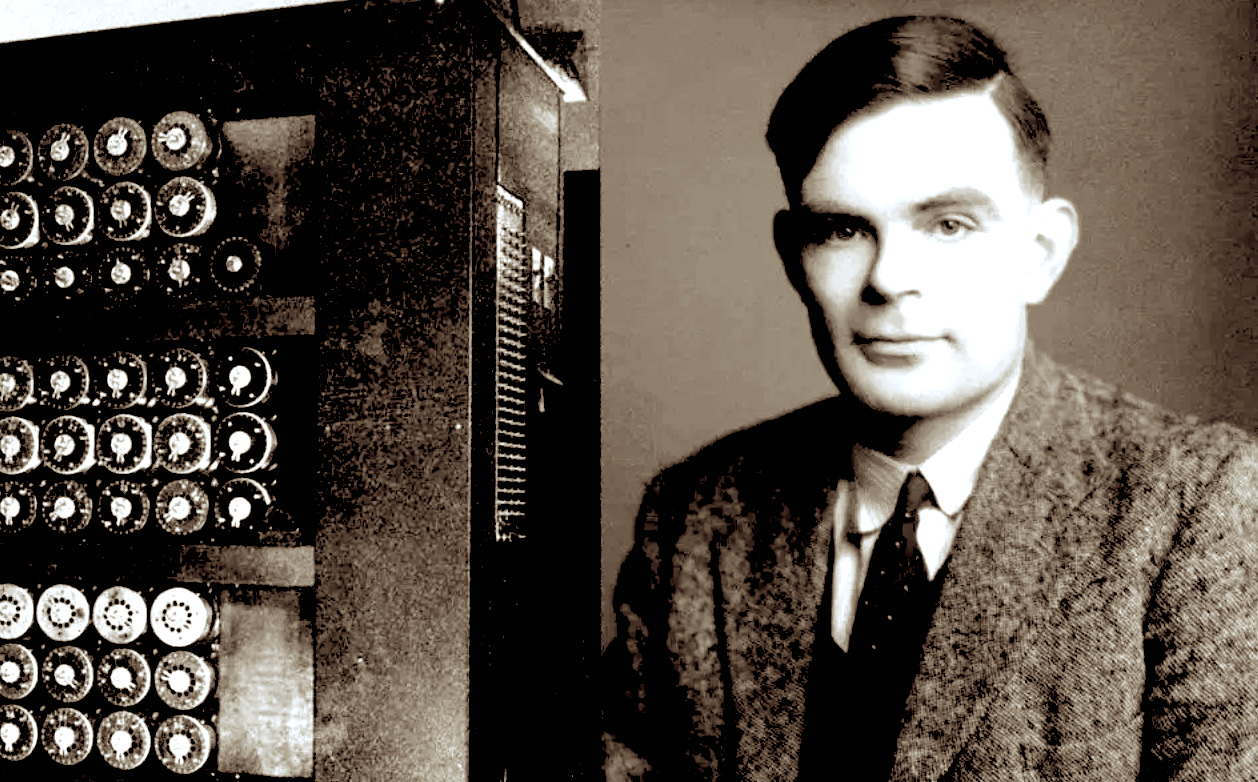
Given how massive a role artificial intelligence has played in the discourses of the last few years, it would be unsurprising if many readers aren’t already conversant with the term “Turing test”. It’s often invoked as if it’s an actual test, the results of which would provide a verdict on whether something claimed as “artificial intelligence” would actually be intelligent, in some sense of the term. Or conscious. Or a mind. Or something that thinks. Or. . . well, one can go on and on (probably in the next few years someone who doesn’t understand it will suggest it determines something else).
This summer, as I’m teaching an online Introduction to Philosophy class, centered on thought experiments, the last week of which focuses on humans and machines, and conceptions of artificial intelligence, I produced a set of core concept videos on the article where the original formulation of the “Turing test” gets articulated, his 1950 “Computing Machinery And Intelligence”, first published in Mind. I’m having my students engage with that article, not just because it makes significant early contributions to theorizing about artificial intelligence, but also so that they can see for themselves what the actual test is that Turing proposed.
Alan Turing was a polymath, ranging over and making contributions within a number of distinct but interrelated fields: mathematics, philosophy, computer science, cryptography, among others. As you’ll see if you read through that seminal article, he is also judicious, careful, and measured in the claims he makes, the suggestions and speculations he proffers, and his engagement with critics of the notion of artificial intelligence and of the test he proposes.
You’ll also learn, very early on in the article, that the workings of his test are supposed to replace the question “can machines think?” Later on, he remarks that he believes that question, at the time that it is being asked, “to be too meaningless to deserve discussion”. Right there, anyone assuming that the “Turing test” is designed to determine whether a computer does think (let alone, is “conscious”, as Richard Dawkins recently claimed, putting his whole foot in his mouth), ought to realize whatever they think the “Turing test” is, they’ve probably got it garbled up in their head.
To be fair, Turing does project:
I believe that at the end of the century the use of words and general educated opinion will have altered so much that one will be able to speak of machines thinking without expecting to be contradicted
Perhaps he was overly optimistic about the changes in concepts and language by 1999, except for within certain circles (and of course science fiction). Even today, setting aside the admittedly wide discourses of AI-hype, whether or not machines can be rightly said to think remains a deeply controversial matter.
But perhaps that’s not the main point. Look carefully at what Turing conjectures. He doesn’t say that by the end of his century (or even the midpoint of ours), machines will think. He just suggests that people will be willing to talk about machines as “thinking,” whatever they happen to think that means.
Enough preambling, you say? What’s the actual original “Turing test”? As it happens, he never calls it that. Frankly it would have been a bit weird for him to have done so. He calls it instead the “Imitation Game”. But that is indeed the original Turing test. How does it work? Well as it happens, it is a little more complicated than the simplified versions that people have been calling “Turing tests” for decades. It starts with a “parlor game”.
It is played with three people, a man (A), a woman (B), and an interrogator (C) who may be of either sex. The interrogator stays in a room apart front the other two. The object of the game for the interrogator is to determine which of the other two is the man and which is the woman. He knows them by labels X and Y, and at the end of the game he says either "X is A and Y is B" or "X is B and Y is A." The interrogator is allowed to put questions to A and B. . .
Notice so far that there are no computers or machines involved at this point. He is setting it up for bringing one in though. In order to make the deception easier, the communication doesn’t take place through voices (which could be a giveaway), but rather in written or typewritten form, or even better via “teleprinter.
Now here is where he brings in a computer:
We now ask the question, "What will happen when a machine takes the part of A in this game?" Will the interrogator decide wrongly as often when the game is played like this as he does when the game is played between a man and a woman? These questions replace our original, "Can machines think?"
The original imitation game, at least as far as it involves a computer, doesn’t actually bear or whether a machine can think or not. That question is “replaced”. And it definitely isn’t framed as a test that takes place through the interactions between a human being on one side of a terminal and either a human being or a computer on the other.
The original Turing test has a human being engaging in conversation with a human and a computer, trying to distinguish which one is the person and which is the machine. If the human interrogator mixes them up often enough, then the computer has passed the test. Turing deliberately reframes “can machines think” into "are there imaginable digital computers which would do well in the imitation game?" That’s it. Do well. Not fool a person 99% of the time. Not fool 99% of humans. Just “do well”.
And the game, in its original formulation, remains one between three players, as Turing’s final formulation makes crystal clear:
Is it true that by modifying this computer to have an adequate storage, suitably increasing its speed of action, and providing it with an appropriate programme, C can be made to play satisfactorily the part of A in the imitation game, the part of B being taken by a man?"
We should also point out that in this article, Turing tosses out an idea of, but doesn’t follow up on, yet a third configuration of the “Imitation Game”
Provided it could be carried out sufficiently quickly the digital computer could mimic the behavior of any discrete-state machine. The imitation game could then be played with the machine in question (as B) and the mimicking digital computer (as A) and the interrogator would be unable to distinguish them.
I’ll bring this to a close by responding to a common sort of retort that at least some people almost can’t help making when they encounter one of these kinds of “here’s the original version of X”. Someone might respond: I’ll concede that Turing’s conception of his test is quite different in structure, scope, and significance is very different than what many people (including theorists of AI) have been calling “the Turing test” for decades. But who cares?
And that’s perhaps the crux of it. Who does care? Definitely not everyone. Perhaps not even a lot of people. It really depends on whether you value accuracy and complexity. It depends on whether you can balance in your mind both a broader, different, arguably less accurate usage with an original meaning intended by the person who puts it into circulation. Some can. Some can’t, or if they can, choose not to. And that’s where I’ll leave the matter of the “Turing test”, in the hands of you, the reader. We’ll see what you make of it.
Gregory Sadler is the founder of ReasonIO, the co-founder of The Stoic Heart®, a speaker, writer, and producer of popular YouTube videos on philosophy. He is co-host of the radio show Wisdom for Life, and producer of the Sadler’s Lectures podcast. You can request short personalized videos at his Cameo page. If you’d like to take online classes with him, check out the Study With Sadler Academy.