
Don’t Give Them Time
Jerks don’t deserve your most scarce resource, so stop giving it to them!


(This article was originally published several years back in my Medium publication Practical Rationality. Since I referenced it recently, and think it might be useful for some readers, I’m republishing it here, without making any updates to it)
Doing philosophy within much more public settings than most of my colleagues, I get a lot of opportunities for conversations with people com ing from a vast variety of backgrounds, perspectives, and commitments. On the whole, that’s a good thing.
Any qualms I had about being out there, not only in text or voice, but quite literally allowing people to put a face (and a body) to a name, producing videos in my YouTube channel, quit affecting me so long ago that I can’t say I really remember them.
I’m not on every social media platform. Who could be, realistically speaking? But I’m active on Twitter, Facebook, and LinkedIn. When I can find the time, I answer questions on Quora. I edit the blog Stoicism Today, write in my own blog, Orexis Dianoētikē, and contribute to a few other blogs. I give public talks, hold online events, and appear as a guest to talk about philosophy on radio, podcasts, videos channels, and (more rarely) television.
That much public engagement draws a lot of correspondence and conversation with other people. Emails, DMs, comments, some of it private, some of it quite public. I’d say I probably devote on average at least 10 hours a week to considering and responding to comments, or replying to emails and messages. Some of those who write express surprise or even delight to get a response. Others are much less happy with the content, the tone, the rapidity, or the comprehensiveness of my replies. Like I noted, people who write me span a pretty wide range.
Generally, the conversations I do engage in go pretty well. Quite a few of them are people wanting to get clarification or some recommendations. Some bring valuable contributions to discussion, widening or deepening consideration of the topic at hand. Sometimes we joke around, which I certainly enjoy. Sometimes the conversations shift to, or even start, on much more negative, tendentious, contentious grounds. That’s not always bad, of course, but those sorts of interactions often start, or go, bad, in a variety of ways.
For the last year or so, I’ve been mulling over, and occasionally discussing, a number of interconnected topics bearing on the conditions for productive conversation online. Some of these have to do with blocking or banning someone from a platform, a practice I engage in on my own channels, blogs, and social media (I held a Philosophy Pop-Up session about this last fall).
Some involve reasonable expectations for those who want to engage in conversation, or even just to say their piece on someone else’s internet space. There’s a host of other related issues. And I’ll confess this: while I do have consistent practices in these matters, I have yet to work out a coherent policy, let alone systematically work out and set down my thoughts on how these matters ought to be handled
I saw two things today that spurred me to get cracking on a bit of that work, what I’m hoping to start doing in this piece. One was an email, and the other a Twitter post.
The email was some continuing correspondence from a rather disagreeable, demanding, and entitled person, and it was regarding an online platform, where that person is frankly fortunate not to have simply been blocked (which could of course happen down the line, depending on how that person chooses to behave), but has had their involvement somewhat restricted. That person strikes me as one of those fairly intelligent bully-types who takes potshots clearly intended as tendentious, but attempts to hide this behind moral language and concepts of that online community. Pick any group and you’ll find people like that. Be an active member, and sooner or later, you’ll wind up in their crosshairs.
The other was a humorous tweet from someone I follow:
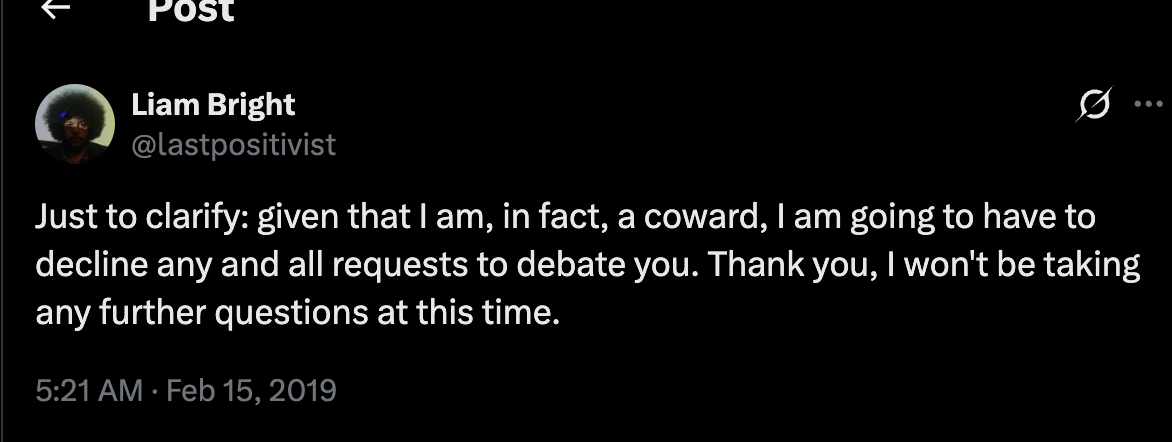
That’s actually a great preemptive response for all of the demands that one gets, generally from those somewhere in the jerk to jackass continuum, “debate me. . . or you’re a coward!” People like that must believe (or at least be rhetorically committed to the view) that those who won’t continually engage in conversation with them, no matter how poorly-informed, abusive, or ridiculous that would-be-”debator”’s contributions, are simply afraid to do so. A straightforward dilemma, with no third possible position.
May as well just grab that second horn then, and let those yahoos do their posturing. Only other yahoos (or dipshits, or whatever other well-deserved derogatory term you’d prefer) will buy that narrative of your “cowardice”.
As I noted above, this is just the start of my setting down my thoughts about these matters, so I haven’t got some comprehensive, systematically worked out, debated-with-the-decent take on all of this. I do, however, have one main insight about how to handle the contentious, the tendentious, the “debate me bro!” types.
Jerks don’t get time.
Or if they do get time, it’s the minimum possible.
When they do get it, time allotted to them comes after others get attended to.
For every one of us, time is in limited supply. We all get the same 24 hours each day, however we spend it. You can manage your time. You can hire people to help you do things that would otherwise consume more of it. You can schedule it, block it out, measure it. It doesn’t matter. You get that 24 hours.
And you get whatever time your life contains. You could die tomorrow perhaps. Or you might live on for decades. But that life of yours is going to come to an end. And, if you’re like me, you’ve probably got more of your life behind you in the past than you can reasonably anticipate for yourself in the future.
That time is yours. Every person that you devote time to is getting it in some sort of exchange or as a gift, and it is up to you ultimately who you devote time to, how much of it, and whether and when you cut them off. People who think they are entitled to your time when they really aren’t are deluded about their own self-importance, or perhaps the importance of whatever ideas or cause or issues they want to argue about with you, whatever “matters of principle” they want to first lecture (or hector) you about and then demand your response to.
My policy, what there is of it so far, is pretty simple. My time is in short supply. I’m a busy guy, and already spend a lot of my time engaging with a lot of people. Unless someone is paying me for my time (and even then, I’ve got terms and conditions), I don’t owe my time to them.
Or my thought, whether my best well-thought out reflection or my most from-the-hip quip.
Or my attention.
If someone decides to act like a jerk, I may generously devote a bit of time to making clear to them that they’re doing so, and that they need to behave differently if they want any further conversation. If they decide then to double down and keep on the same tack, under the assumption that I somehow owe it to them to take them seriously as a conversation partner, or even frankly, to care about their views, their feelings, where they’re coming from, and so on, then they misused the time they were allotted.
Conversations with jerks, just going from my own experience (I’d be interested to see what others have to say about it, and I’d make the time to read those remarks or comments!), usually turn out to be a waste of time in one of two ways.
Either the conversation really never does go or get anywhere. There’s no resolution. Whatever time one devoted to that whole exchange is pretty much a total loss. (Granted, some useful insights might come out of it; a topic for another time)
Or the conversation does get somewhere, but because of the intransigence, the poor communication or emotional management skills, or the downright dickishness of the interlocutor, getting there requires far more time than it ought to have. Far more, that is, than similar conversations with more reasonable interlocutors (conversation partners arguing in genuine good faith) would have required to attain the same results.
So again, what I’ve started doing, and it has worked out quite well so far, is that if someone wants to consistently and continually behave like a jerk, after I initially gave them some time, I quit having time for and giving time to that person. Those aren’t actions or conditions they are entitled to, even if they mistakenly think or feel that they are.
For me that means not just discontinuing interaction, often with the chipper brush-off “good luck with your studies”, but also not even devoting any further thought, emotion, or words to them. Other people who are more deserving conversation partners get my available headspace and my time.
Usually that’s the end of it. If someone still wants to push and push, platforms let you block or ban people. If for some reason I’m stuck dealing with that person, so long as they keep acting like a jerk, they then become my lowest priority. I get to dealing with them, or responding to them, when I get around to it, and they don’t get long, thoughtful replies. They get the bare minimum, and they get it out of whatever spare time I have left after doling it out to others.
That leaves me open to taking the time (of which I never have quite enough) and devoting it to people who do value it, who view my time not as their prerogative or entitlement, but as the scarce commodity it is, but a gift I happily give out to those who appreciate it.
Gregory Sadler is the founder of ReasonIO, a speaker, writer, and producer of popular YouTube videos on philosophy. He is co-host of the radio show Wisdom for Life, and producer of the Sadler’s Lectures podcast. You can request short personalized videos at his Cameo page. If you’d like to take online classes with him, check out the Study With Sadler Academy.
When I was much younger I often initiated and participated regularly in spirited discussion, frank exchanges of views, pissing matches, and occasionally an actual well-reasoned debate. These were all often fueled by ego, testosterone, and alcohol in even measures. I’ve mostly left the ego, alcohol, and probably a good amount of the testosterone behind. What’s left is a realization that people with significant expertise in my field of interest are doing me a favor by engaging with me, and I should respect their time. Moreover, I personally feel the hand of time on my shoulder and have much more respect for how precious that commodity is. Although I’ve only engaged personally with you on a few occasions , I notice you set good boundaries for the obvious trolls, and are pretty patient (gracious even) with the merely ignorant (me included). As someone who has struggled with patience in various training and teaching tasks over the years, I admire that. What I’m trying to say is, it’s pretty obvious that the time you “take back” from the jerks, you likely pour back into your students and friends.
I've been considering this kind of thing lately, but in a different, more personal context, unrelated to Internet jerks. I've had trouble with a family member who is consistently disrespectful and chaotic and I'm sometimes not sure how to reconcile Christ's injuction of unconditional forgiveness and charity with this person's intransigence, disrespect, and _insatiable_ demand on my (and my wife's) time. It seems the only way to placate this person is to do as she says, but then I'm complicit in her counter-productive chaos, at the expense of my dignity and self-respect. And, as her approach seems destructive, I don't think it's charitable to indulge and support. So, maintaining appropriate boundaries in light of the radical demands of Christianity has been a bit confusing for me over the past year. I've actually never dealt with such interpersonal difficulty in my life, and I'm nearing 40.